Blog

How Many Grafts Do You Actually Need? Understanding Your Hair Loss Stage

How Many Grafts Do You Actually Need? Understanding Your Hair Loss Stage

Get an Offer Now

Medical of Istanbul

How Many Grafts Do You Actually Need? Understanding Your Hair Loss Stage

One of the most common questions people ask when considering a hair transplant is: How many grafts will I need? The answer depends on several factors, including the stage of hair loss, the size of the thinning area, hair characteristics, and the availability of donor hair. Understanding your hair loss stage is the first step toward setting realistic expectations and choosing the right treatment plan. In this guide, we explore how graft requirements are estimated and what factors influence the final number.


How Many Grafts Do You Actually Need? Understanding Your Hair Loss Stage

Understanding the Different Stages of Hair Loss

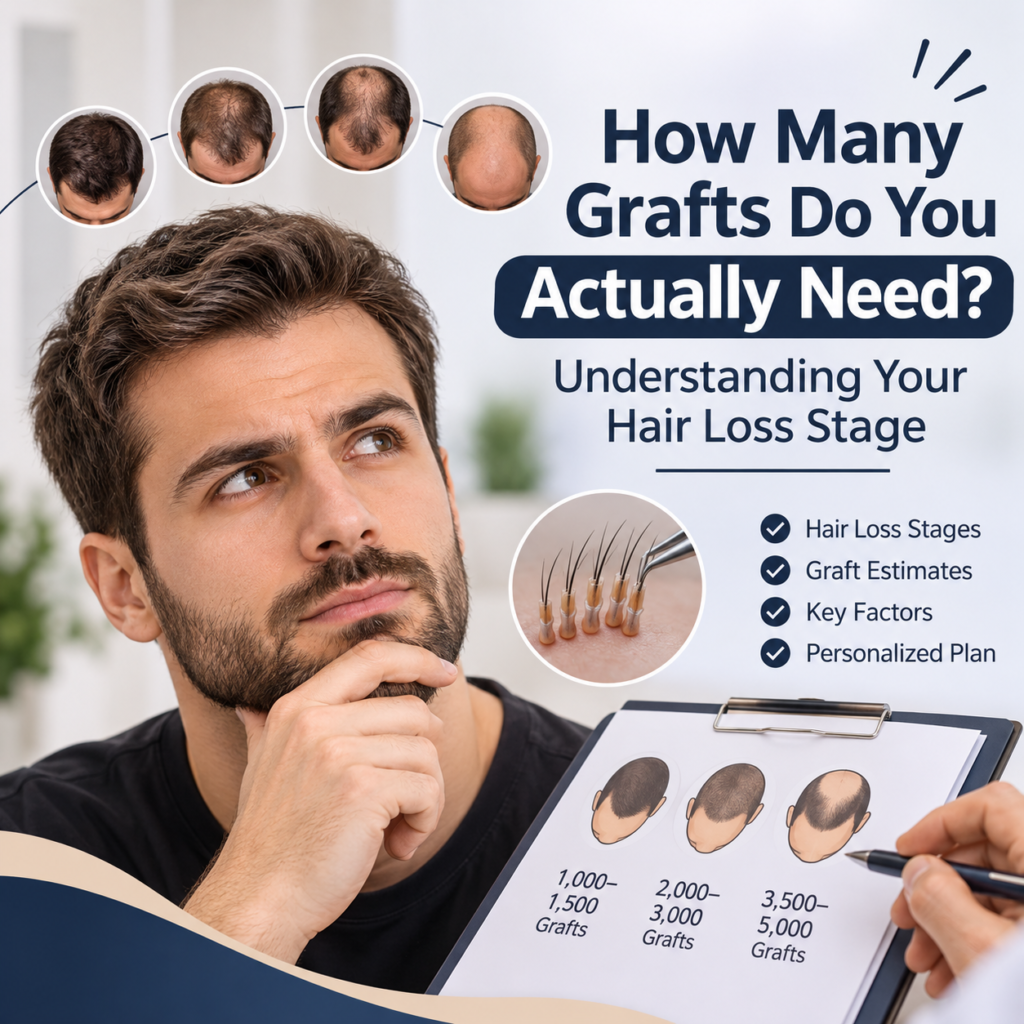
Hair loss typically progresses gradually, and specialists often use the Norwood Scale to classify male pattern baldness into seven stages. Early stages involve slight recession around the temples, while more advanced stages may include significant hair loss across the front, middle, and crown areas. Identifying your stage helps specialists understand the extent of hair loss and determine which areas require treatment. However, two people at the same stage may still need different numbers of grafts.

How Many Grafts Are Needed at Each Stage?

The number of grafts varies depending on the size of the affected area and the desired density. As a general estimate, early hairline restoration may require around 1,000–1,500 grafts, while moderate hair loss can require approximately 2,000–3,000 grafts. More advanced cases may need 3,500–5,000 grafts or more, sometimes across multiple sessions. These figures are only estimates, as the final number must be determined through an individual medical assessment.

Factors That Influence the Number of Grafts

Hair loss stage is not the only factor specialists consider when calculating graft requirements. Hair thickness, natural density, hair color, scalp contrast, and the size of the recipient area can all influence the result. For example, thicker hair may create the appearance of greater coverage with fewer grafts, while fine hair may require a different density strategy. The patient's donor area is equally important because it determines how many healthy grafts can be safely extracted.

Understanding the Importance of the Donor Area

The donor area, usually located at the back and sides of the scalp, provides the follicles used during transplantation. Its density, quality, and available graft count play a major role in determining the feasibility of the procedure. Even if a patient needs 4,000 grafts, their donor area may not safely support that number in one session. Experienced specialists prioritize donor preservation to avoid overharvesting and maintain enough healthy follicles for potential future treatments.

Medical of Istanbul

Why a Personalized Hair Transplant Evaluation Matters

There is no universal graft number that works for everyone. A successful hair transplant requires a personalized approach that considers current hair loss, future hair loss progression, donor capacity, and the patient’s expectations. During an evaluation, specialists examine photographs or perform a direct scalp assessment to estimate the required graft count and develop an appropriate treatment plan. The goal is not simply to transplant as many grafts as possible, but to achieve natural-looking coverage while protecting the donor area.

Before hair Trasnaplant

Get an Offer Now

News about Medical of Istanbul

Blog

How Many Roots Should Be Planted Per Cm2 in Hair Transplantation?