Blog

Understanding Hairline Design: How Surgeons Plan a Natural Look

Understanding Hairline Design: How Surgeons Plan a Natural Look

Get an Offer Now

Medical of Istanbul

Understanding Hairline Design: How Surgeons Plan a Natural Look

When people think about a successful hair transplant, they often focus on the number of grafts or the overall density of the new hair. However, one of the most important elements of a natural-looking result is the design of the hairline. The hairline frames the face and plays a major role in how natural the final transformation appears. Even a technically successful transplant can look unnatural if the hairline is positioned incorrectly or designed without considering the patient’s individual features. For this reason, experienced surgeons carefully evaluate facial proportions, age, existing hair growth, donor capacity, hair characteristics, and the possibility of future hair loss before creating a personalized hairline plan.

Understanding Hairline Design: How Surgeons Plan a Natural Look

Analyzing Facial Shape and Proportions

Hairline design begins with a detailed evaluation of the patient’s facial structure and proportions. Every person has a different forehead height, face shape, bone structure, and natural pattern of hair growth, so the same hairline cannot simply be used for every patient. The surgeon examines the relationship between the forehead, eyebrows, temples, and existing hair to determine where the new hairline should begin and how it should frame the face. Rather than focusing only on lowering the forehead, the objective is to create balance between the upper and lower parts of the face. The surgeon may also consider whether the face is round, oval, square, or elongated when planning the overall shape. A carefully positioned hairline should complement these natural characteristics without appearing too low, too high, or excessively symmetrical. This personalized approach is one of the key factors that helps the transplanted hair blend naturally with the patient's appearance.

Understanding Hairline Design: How Surgeons Plan a Natural Look

Considering Age and Future Hair Loss

A natural hairline should not only look appropriate immediately after a hair transplant—it should also continue to look suitable as the patient gets older. This is why age and the expected progression of hair loss are important parts of the planning process. Some patients, particularly younger individuals, may initially prefer a very low or dense hairline similar to the one they had during their teenage years. However, creating an excessively low hairline may use a significant number of donor grafts and could become difficult to maintain if additional hair loss occurs in the future. Surgeons therefore often take a more conservative approach, considering the patient’s current pattern of hair loss, family history, available donor hair, and potential future thinning. The goal is to use the donor area responsibly while creating a hairline that looks balanced today and remains visually appropriate over time. Long-term planning is especially important because donor hair is limited, and some patients may require additional treatment or transplantation in the future.

Creating Natural Irregularities

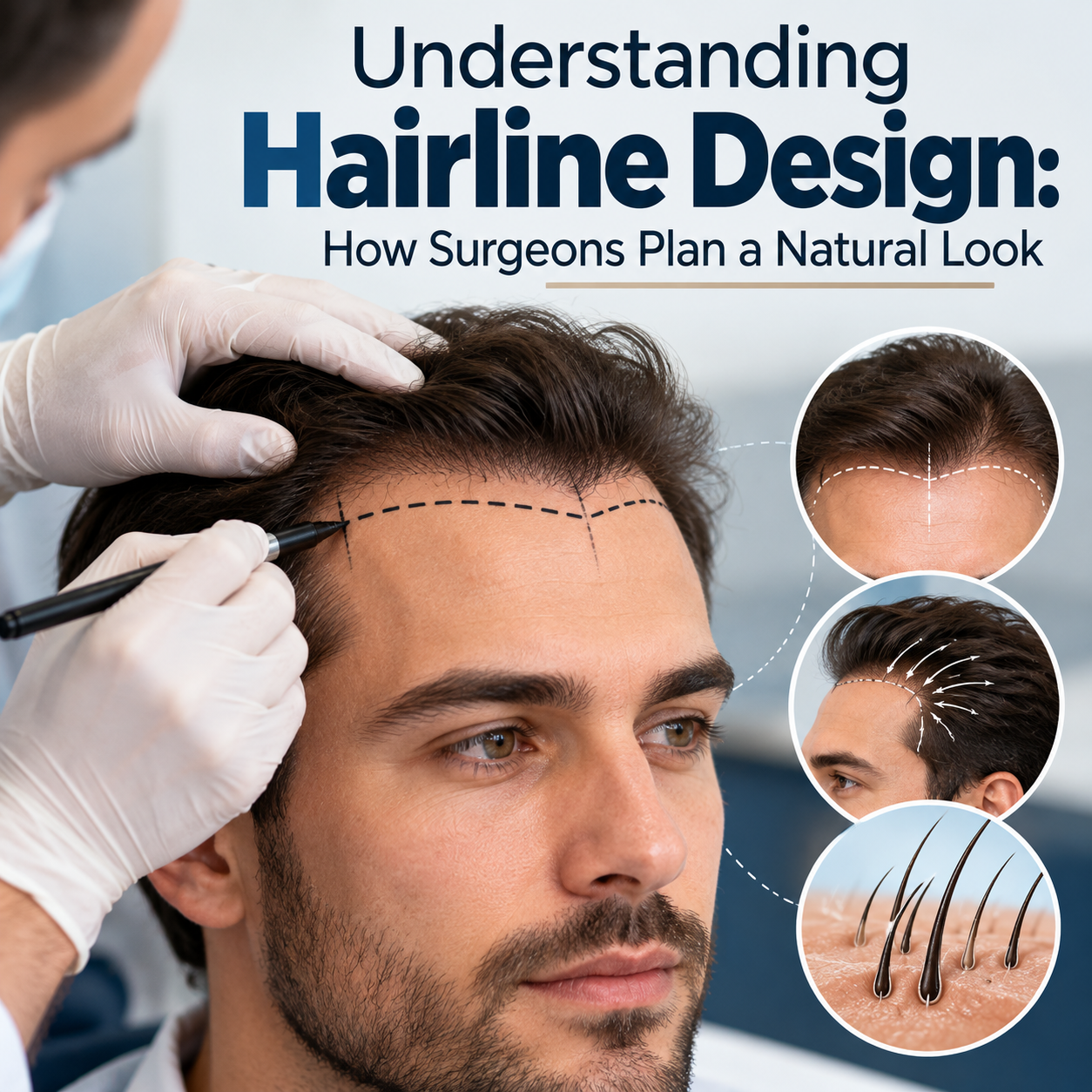
One of the biggest differences between a natural hairline and an artificial-looking one is the presence of subtle irregularities. Natural hairlines are rarely perfectly straight, completely symmetrical, or uniformly dense. Instead, they usually contain small variations in height, spacing, and direction, along with finer individual hairs around the front. Surgeons attempt to reproduce these natural details when designing and implanting the new hairline. Single-hair follicular units are often selected for the frontal edge because they can create a softer and more gradual transition between the forehead and the denser hair behind it. Small variations may also be incorporated into the design so that the hairline does not resemble a sharp line drawn across the forehead. These details may seem minor, but they can have a significant impact on the final appearance. When properly planned, the irregularities are subtle enough that they are not immediately noticeable, yet they help the overall hairline look more realistic and naturally grown.

Choosing the Right Hair Direction and Density

The position and shape of the hairline are only part of the design process. Surgeons must also carefully plan the angle, direction, distribution, and density of the transplanted hairs. Natural hair does not grow vertically from the scalp in exactly the same direction everywhere. The growth angle changes depending on the area, particularly around the frontal hairline and temples. During transplantation, grafts are therefore placed according to the patient’s natural growth pattern so that the new hair can blend more effectively with the existing hair. Density must also be distributed strategically. The very front of a natural hairline usually has a softer appearance, while density gradually increases farther behind it. Single-hair grafts are commonly used along the frontal edge, while follicular units containing two or more hairs may be placed behind them to provide greater visual density. Hair thickness, texture, curl, and color can also affect how much coverage a certain number of grafts can provide. By considering all of these elements together, the surgeon can create a smoother transition and avoid an overly dense or artificial-looking frontal line.

Medical of Istanbul

Personalizing the Hairline for Each Patient

Hairline design is not a one-size-fits-all process. Each patient has different expectations, hair characteristics, levels of hair loss, donor-area capacity, and facial features, which is why the treatment plan should be individualized. During the consultation, the surgeon evaluates factors such as hair thickness, texture, curl pattern, scalp condition, existing density, donor quality, and the extent of thinning or baldness. The patient’s preferences are also an important part of the discussion. In many cases, the proposed hairline is drawn directly on the scalp before the procedure so the patient can see its position and shape and discuss possible adjustments with the medical team. However, the final design must also remain realistic from a medical perspective. A patient may want an extremely low or very dense hairline, for example, but the available donor supply and expected future hair loss may make a more conservative design preferable. Finding the right balance between the patient’s goals and long-term surgical planning is essential for achieving a result that looks natural and uses the available grafts effectively.

Understanding Hairline Design: How Surgeons Plan a Natural Look

Get an Offer Now

News about Medical of Istanbul

Blog

How Many Roots Should Be Planted Per Cm2 in Hair Transplantation?